Free Shipping Sitewide | 1 Year Warranty

Skid Steer vs. Wheel Loader: Which to Buy in 2026?
2/28/20264 min read
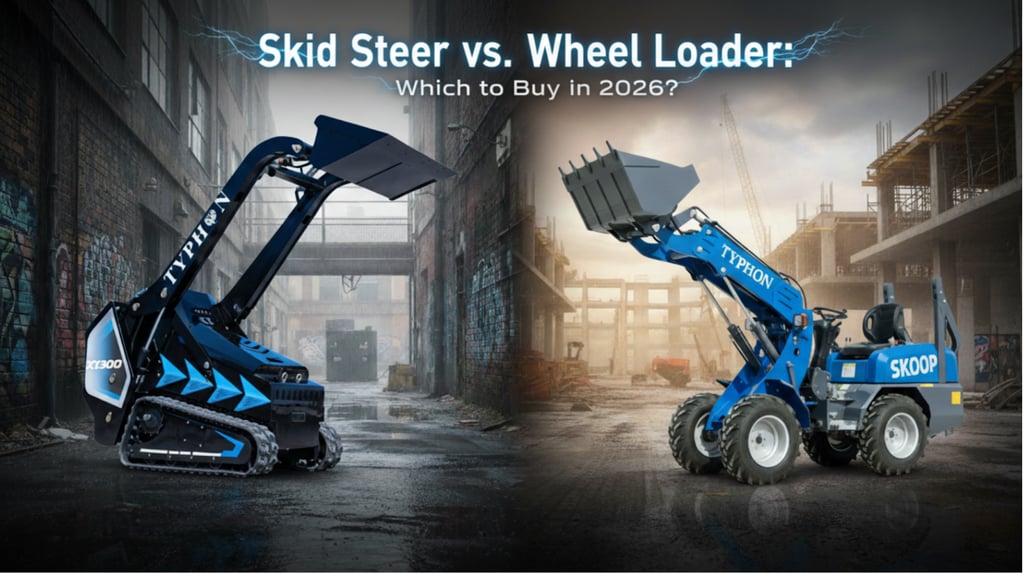
Selecting the right heavy equipment is a foundational decision that directly influences project efficiency, operational costs, and overall profitability. When it comes to material handling on a job site, two of the most common machines are the skid steer and the wheel loader. While both are designed to move materials, their distinct capabilities make them suited for very different tasks and environments.
Choosing between a skid steer and a wheel loader requires a clear understanding of your specific needs. This guide provides a detailed comparison to help you determine which machine is the most reliable and effective investment for your business in 2026. We will analyze key differences in versatility, job site application, and total cost of ownership to ensure you make a confident and informed decision.
Job Site Application and Maneuverability
The primary distinction between a skid steer and a wheel loader lies in their design and how they navigate a job site. This fundamental difference dictates where each machine excels.
The Compact Power of a Skid Steer
A skid steer is defined by its compact frame and unique steering mechanism. The wheels on each side are locked in synchronization, and the machine turns by "skidding"—speeding up the wheels on one side while slowing down the other. This results in a zero-turn radius, allowing the machine to pivot within its own footprint.
Thanks to this agility, a skid steer for sale is an ideal solution for tight working environments such as residential construction, indoor demolition, backyard landscaping, and agricultural barns. It easily navigates narrow pathways, sharp corners, and crowded spaces where larger equipment cannot operate efficiently. Its compact size also makes transportation simple, as most skid steer loaders can be hauled between job sites using a standard trailer, reducing logistics costs and improving overall job flexibility.
The Power and Stability of a Wheel Loader
A wheel loader, particularly a compact wheel loader, is a larger machine that uses articulated steering. It pivots in the middle of its chassis, requiring more space to turn. While less nimble than a skid steer, this design gives the wheel loader superior stability, a smoother ride, and a higher vantage point for the operator.
Wheel loaders are built for open spaces and larger-scale material handling. They excel at loading dump trucks, moving large piles of gravel or soil across a yard, and clearing snow from large parking lots. The articulated frame and larger tires provide better traction and performance on rough, uneven terrain. The operator sits higher, offering excellent visibility over the stockpile and into the truck bed, which improves both safety and loading efficiency.
Versatility and Attachments
Both machines can be outfitted with a wide range of attachments, but their core design influences how effectively these tools can be used.
Skid Steer: The Multi-Tool of the Job Site
The skid steer is often called the "Swiss Army knife" of construction equipment for good reason. Its hydraulic system is designed to power hundreds of different attachments, from augers and breakers to trenchers and stump grinders. The machine's low center of gravity and direct power transfer make it highly effective for tasks that require significant downforce.
Because you are positioned directly over the attachment, a skid steer offers excellent precision for detailed work like grading or milling. If your business model relies on offering a diverse range of services—from demolition and drilling to landscaping and site cleanup—a skid steer provides the versatility to tackle multiple jobs with a single base machine.
Wheel Loader: The Material Handling Specialist
A wheel loader is, first and foremost, a master of lifting and carrying. Its primary function is moving bulk materials, and its design is optimized for this task. The kinematics of the lift arms provide a greater lift capacity and higher dump clearance compared to a similarly sized skid steer. This makes it far more efficient for loading high-sided trucks and hoppers.
While wheel loaders can use attachments like forks, brooms, and snowplows, their attachment ecosystem is generally more focused on material handling. They are less suited for ground-engaging work that requires the dexterity and downforce of a skid steer. If your primary need is moving large volumes of material quickly and efficiently, the wheel loader is the more specialized and productive tool for the job.
Comparing Cost of Ownership
The initial purchase price is only one part of the financial equation. A true comparison must include long-term operating and maintenance costs.
Upfront and Operating Costs
Generally, a skid steer has a lower initial purchase price than a compact wheel loader of a similar horsepower rating. This makes it a more accessible entry point for smaller businesses or those just starting to build their fleet.
However, the operating costs can be higher. The "skid" turning mechanism causes rapid tire wear, which can become a significant recurring expense, especially when operating on hard surfaces like asphalt or concrete. Skid steers also tend to consume more fuel for the same task compared to a wheel loader, as their engines often run at a higher RPM to power the hydraulics.
Maintenance and Longevity
A wheel loader typically has a higher upfront cost, but it often provides a lower total cost of ownership over its lifespan. The articulated steering is much gentler on tires, leading to significantly longer tire life and lower replacement costs. Wheel loaders are also known for their smooth operation, which reduces wear and tear on the chassis and powertrain components.
Because they are built for heavy, continuous-duty cycles, wheel loaders are often engineered for greater durability and longevity. While both machines require diligent daily and preventative maintenance, the reduced tire wear and generally more robust construction of a wheel loader can translate to less downtime and lower long-term repair costs.
Which Machine Should You Buy in 2026?
The right choice depends entirely on a careful evaluation of your primary business needs.
You should choose a skid steer if:
Your work is primarily in confined spaces that demand high maneuverability.
You need a versatile machine to run a wide variety of hydraulic attachments.
Your projects involve detailed grading or ground-engaging tasks.
A lower initial purchase price is a key factor in your decision.
You should choose a wheel loader if:
Your main task is loading trucks and moving large volumes of bulk material.
You operate in open areas and on rough terrain.
Operator comfort, visibility, and long-term operating costs are your top priorities.
You need a higher lift capacity and greater reach.
By assessing your job sites, business model, and budget against these factors, you can invest in the machine that will deliver the most value and productivity for your operations. Our commitment is to provide the reliable equipment and expert guidance you need to make the best choice for your business's success.
Leading provider of heavy equipment solutions in the US such as mini excavator diggers and skid steers. When looking for a reliable mini excavator supplier, look for New Excavator. Quality compact mini excavators backed by a strong after sales service and a widespread inventory of spares.
Contact us for equipment inquiries
© 2026. All rights reserved USA EXCAVATORS
Follow us now